How governments can help protect against cyber threats
"What governments can do to help is really about educating us, making sure the businesses know what they should be doing. Many businesses have been running the same IT teams for the last 10–20 years, and they don't realize we're living in a world now where there's more vulnerabilities found in a single day than there were in a year two years ago." - Danny Jenkins
From the ThreatLocker blog
How PHP2Shell leads to remote code execution—and what you can do to stop it
Technical analysis, indicators of compromise, and mitigation steps
The ThreatLocker Threat Intelligence Team breaks down CVE-2026-109618 and CVE-2026-109619, including how the vulnerabilities lead to RCE, behavioral IoCs, and temporary mitigations if updating immediately is not an option.
Learn what to look for, how to mitigate exposure, and how default-deny controls can help contain exploitation.
NIST releases new guidance for AI incident response
Why Zero Trust matters when agents act autonomously
NIST, the NSA, and CISA have jointly developed 10 voluntary practices for preparing for and responding to incidents involving highly capable AI and superintelligent systems. The guidance covers five stages: prepare, detect, respond, recover, and report.
The guidance aligns closely with Zero Trust in urging organizations not to wait for an incident to discover what their AI agents can access or execute.
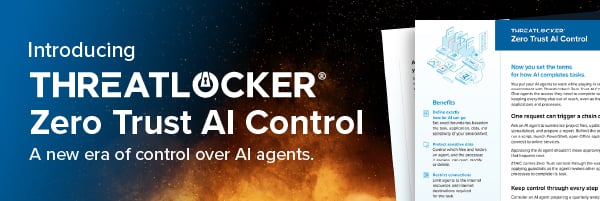
Watch ThreatLocker CEO Danny Jenkins introduce the product, walk through the dashboard, and demonstrate how Zero Trust principles can be applied to AI agents.
AI demonstrates the ability to chain vulnerabilities and bypass multiple security layers
What's happening: Anthropic researchers used an unreleased Claude model to develop five exploit chains targeting Chrome, Android, Linux, Safari, and Windows. The AI combined multiple vulnerabilities to escape browser sandboxes, extract data from a locked Android device, and gain root access to vulnerable Linux systems without authentication or user interaction. Anthropic reported the vulnerabilities through coordinated disclosure, and affected vendors have released fixes.
What defenders need to know: AI-assisted vulnerability chaining is reducing the time and expertise needed to develop sophisticated exploits. Prioritize default-deny and least-privilege controls to limit what attackers and agents can execute or access after exploitation.
Hackers target critical Oracle vulnerability after patch
Unauthenticated flaw could expose sensitive data and enable remote code execution
What's happening: Researchers detected exploitation attempts targeting CVE-2026-101767, a critical Oracle E-Business Suite vulnerability with a CVSS score of 9.8, just days after Oracle released a patch. The flaw allows unauthenticated attackers to exploit SQL injection and potentially execute operating system commands, putting sensitive financial, payroll, HR, and procurement data at risk. Internet-facing systems face the greatest exposure, but internal deployments are also at risk if attackers gain network access.
What defenders need to know: Organizations running Oracle E-Business Suite should apply the latest security updates immediately. If patching isn't possible, restrict access to the vulnerable servlet, limit web-tier access to trusted networks, and monitor for suspicious database activity or unexpected command execution.
Staying ahead of emerging cyber threats takes practical experience, new perspectives, and continuing education.
Zero Trust World is your chance to invest in all three.
Get hands-on experience with popular hacking tools and techniques and the Zero Trust controls that stop them, earn up to 35 CPE credits, grow your network, and learn how to stop tomorrow's threats.
Use code ZTWWEEKLY27 to save $200 on your registration.