“Make sure that you are very clearly defining, at a file permission level, at an application permission level, an application control level, at an AI control level ... which files, which documents, which other applications on your computer this AI agent can talk to, and when it does talk to them, that those permissions flow through.” - Danny Jenkins
From the ThreatLocker blog
How can you ensure that your AI agents stay within secure boundaries? Breaking down practical ways to secure agentic AI
AI agents are fast becoming part of the furniture across many organizations around the world. The technology brings fantastic efficiency gains, but equally it brings great risk to the table.
The key is letting agentic AI get to work within appropriate boundaries. In this blog, ThreatLocker explores how you can let AI get to work for you in the safest way possible.
Stolen credentials only start attacks, what happens next is crucial
Why Zero Trust controls are vital to stopping cybercriminals taking any further steps
Attackers will intercept valid user passwords, tokens, and authorizations to enter an organizations environment. It's what happens after that which determines the damage, or lack of it, that can be done.
By setting controls that target the steps that attackers need to move successfully within your environment, you will render stolen credentials useless.
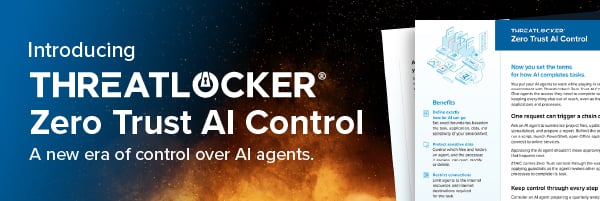
Watch ThreatLocker CEO Danny Jenkins introduce the product, walk through the dashboard, and demonstrate how Zero Trust principles can be applied to AI agents.
Google patches Chrome zero-day already exploited in the wild
A Chrome zero-day has been exploited to run code inside the browser sandbox.
What's happening: Google shipped Chrome 157.0.8103.50 on Nov 9 to fix CVE-2026-125350, a use-after-free bug in the browser’s XML component that Google says already has an exploit circulating in the wild. Google hasn’t said who is using it or how. An anonymous researcher reported the flaw on Nov 6, three days before the patch. A crafted web page can trigger it to run code inside Chrome’s sandbox, and the bug carries a CVSS score of 8.8. Public Chromium patch details reportedly point to libxslt, the library that handles XSLT transformations of XML.
What defenders should do: Update Chrome to 157.0.8103.50 or later and relaunch, since the fix doesn’t apply until the browser restarts. Check each Chromium browser’s release notes rather than assuming a recent build includes the fix. Some analysts suggest disabling XSLT with the XSLTEnabled policy until updates land, though that isn’t Google’s guidance and should be tested first.
Barracuda email gateways under attack: Two flaws chain into root access
Attackers chain two Barracuda email gateway flaws to gain root access without a login.
What's happening: Barracuda said late on Nov 9 that attackers are exploiting two flaws in its Email Security Gateway (ESG) against a small number of organizations. CISA added both CVEs to its KEV catalog the next day. CVE-2026-116606 (CVSS 9.3) is an authorization bypass that lets an unauthenticated attacker restore a crafted configuration backup and rewrite the appliance’s settings. CVE-2026-111560 (8.6) is a command injection that normally requires admin access. Chained, they give an attacker root without a login. The catch is that the attacker has to reach the ESG’s administrative interface, a detail Barracuda clarified on Nov 5 after first listing the bug as requiring admin authentication.
What defenders should do: Upgrade ESG appliances to firmware 9.4.0.030 or later, which addresses both flaws. Limit who can reach the admin interface, and review any appliance that was exposed before patching, since confirmed exploitation means patching alone won’t show whether an attacker got in first.
Staying ahead of emerging cyber threats takes practical experience, new perspectives, and continuing education.
Zero Trust World is your chance to invest in all three.
Get hands-on experience with popular hacking tools and techniques and the Zero Trust controls that stop them, earn up to 35 CPE credits, grow your network, and learn how to stop tomorrow's threats.
Use code ZTWWEEKLY27 to save $200 on your registration.